
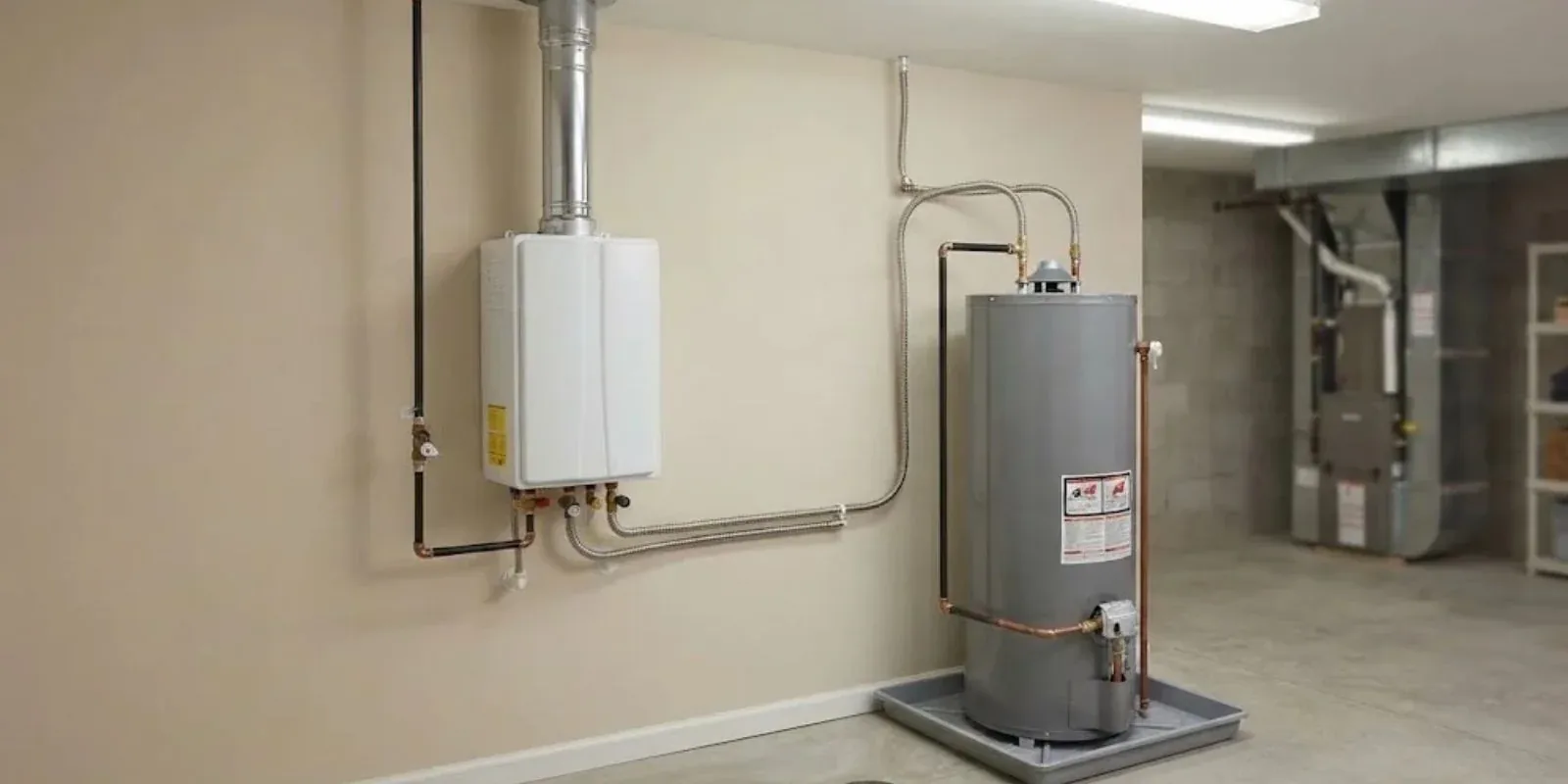
Tankless Water Heater Service in Mount Laurel, NJ
Hot water on demand, without a big tank, if the house and the gas line can support it. A licensed plumber installs, repairs and descales tankless units and tells you plainly when a tank is the better choice.
What a tankless water heater is and who it suits
A tankless water heater heats water only when a tap opens, using a gas burner or electric elements to warm the flow as it passes through a heat exchanger. There is no stored supply, so it cannot run out the way a tank does, but it can only heat so many gallons per minute. Service covers installing, repairing, flushing and descaling these units.
It suits a household that wants floor space back and a steady supply of hot water for back to back showers, as long as the gas line, vent and budget match the unit. It is rarely the cheapest way to fix a bad tank, and the sections below explain why.
Running out of hot water, high gas bills and cold bursts, the symptoms that lead to tankless
Most people reach this page after an experience rather than a product search. The tank runs out halfway through the second shower. The utility closet takes up a corner of the basement you want back. The gas bill climbs every winter while the tank keeps its water hot all night for nobody. Or you already own a tankless unit and it delivers a burst of cold water in the middle of a shower.
Each of those is a different problem with a different answer. A tank that runs out may just be too small or choked with sediment, and a bigger tank or a new element can fix it for less. A unit that cannot keep up, uses more fuel than you expected or turns cold mid-use is where a tankless design, or a repair of the one you have, earns its place.
Sorting your hot water complaint
Match what you notice to the most likely cause before you spend money.
- Hot water runs out when two showers or a shower and the dishwasher run at once.
- Water stays lukewarm even with the tap fully on and the setting high.
- A burst of cold water arrives in the middle of a hot shower, then heat returns.
- The unit shows an error code or shuts off after a minute or two.
- Flow at the tap is weaker than it used to be, with scale flakes in the aerator.
- A clicking, rumbling or kettle sound comes from the unit as it fires.
- Water drips from the unit or its connections, which needs a plumber to look.
Thinking about tankless or need yours flushed? Call the 24/7 line to book a visit.
Call (609) 547-1417The cold sandwich and how to reduce it
The cold sandwich is the slug of cold water that arrives when you pause a shower and restart it. The pipe still holds hot water from the first use, then the unit has to fire again and the cold water already in the line gets pushed through before new heat arrives. Short pauses, low flows and long pipe runs make it worse.
Fixes include keeping the flow high enough for the sensor to sustain the burner, adding a small buffer tank, installing a recirculation line, or shortening the distance to the main bath. A plumber looks at the specific unit and layout before recommending which of these helps.
Tankless compared with a tank, honestly
There is no universal winner, and the table shows the trade-offs.
| Choice | Strength | Trade-off |
|---|---|---|
| Condensing gas tankless. | Highest efficiency, cool exhaust in plastic pipe. | Needs a condensate drain, power, and costs more up front. |
| Non-condensing gas tankless. | Can reuse some existing vent paths, lower purchase cost. | Hotter exhaust, usually needs stainless vent, lower efficiency. |
| Electric tankless. | No venting, compact. | Very large electrical load, may need a service upgrade. |
| Standard tank. | Lowest install cost, simple to repair. | Can run out, takes floor space, loses heat standing idle. |
| Heat pump tank. | Low running cost. | Needs air space and a drain, see water heater installation. |
Gas line and venting upgrades the swap often needs
A gas tankless burner can demand several times the fuel input of a tank burner. The existing gas line, sized for a 40 gallon tank, may be too small to feed it at full fire, which shows up as a unit that shuts down on a cold morning. Upsizing the pipe from the meter to the heater is the most common hidden cost of the switch.
Venting changes too. A tank uses a natural draft flue, while a tankless unit uses sealed plastic or stainless vent pipe run through a wall or the roof. Ask the Mount Laurel construction office about permits, and expect the plumber to confirm that the vent length and termination match the model. If a gas smell appears at any point, leave, call 911 and the gas utility from outside, then call our 24/7 line.
Why descaling matters in moderately hard water
The township's water quality summary lists 63 to 138 ppm across the supplies it names. The MUA and New Jersey American Water sit near 80 to 100 ppm. That is moderately hard to hard at the top end. A tankless heat exchanger is a narrow passage with very hot metal surfaces, which is the ideal place for scale to build. Scale cuts flow, lowers efficiency and can trigger error codes or overheating.
Scale builds inside the narrow heat exchanger of a tankless unit faster than it does in a tank. If you have no softener, treat descaling as routine, not as an extra, and ask the plumber about adding a scale inhibitor or a softener on the cold line.
Flushing a tankless heater step by step
The plumber follows the maker's procedure, and this is the usual shape of it.
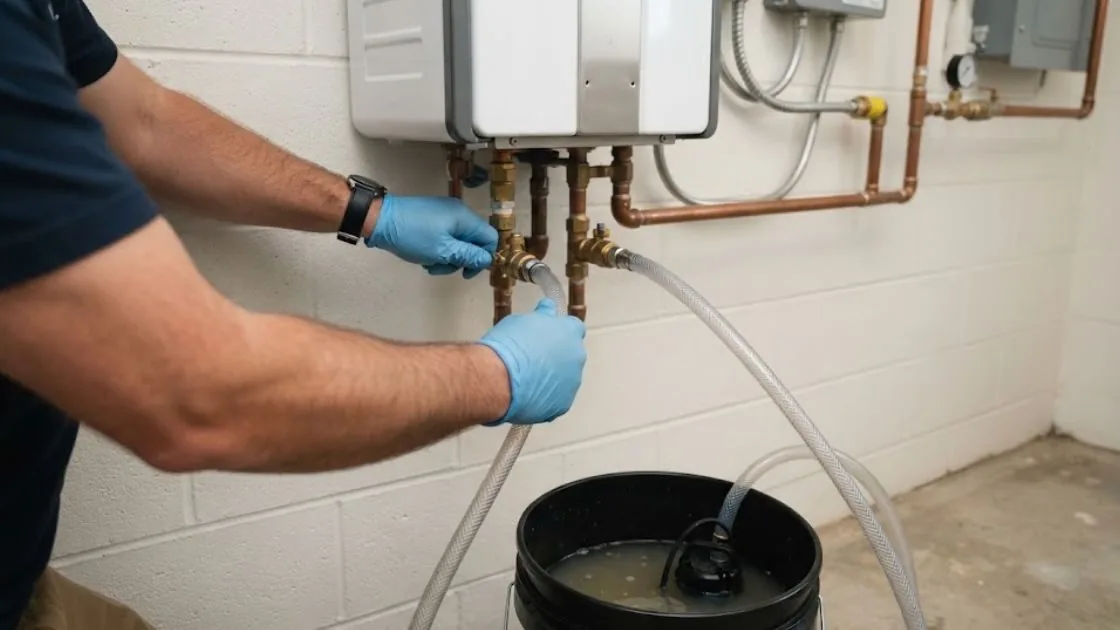
- Isolate the unit. Power and gas are shut off, and the isolation valves on the hot and cold lines are closed.
- Connect the hoses. Service ports are opened and hoses attached to a pump and a bucket of descaling solution, using a product the maker approves, which is sometimes food grade vinegar. Descaling goes through the isolation valves and follows the manufacturer's instructions for that model.
- Circulate. The solution runs through the heat exchanger for the time in the manual, typically about an hour.
- Rinse and clean the filter. The unit is flushed with clean water and the inlet screen is cleaned of scale and debris.
- Reopen and test. Valves, gas and power are restored, and the unit is fired and checked for flow and error codes.
Flow limits and where tankless disappoints
Every unit has a maximum flow at a given temperature rise. In winter, when incoming water is colder, the same unit delivers fewer gallons per minute than in summer. If three fixtures run at once, a smaller unit will cool the stream or limit the flow.
Low flow fixtures can also be too gentle to switch some units on, leaving the water cold. Sizing starts with a count of fixtures and their flow. A plumber who recommends a tank over a tankless unit for a small, low-use house is giving honest advice, not missing a sale. For a leak or failure on an older unit, see water heater repair.
Getting a clear price for tankless work
Tankless projects vary more than tank swaps, so a firm number comes after a site look. The main drivers are gas line size, vent route, condensate and power, and removal of the old tank.
- Unit type and capacity. Condensing, high output and electric models are priced differently.
- Gas and electric supply. A bigger gas line or a new circuit adds work.
- Vent and drain. The route, the material and the condensate line all affect the job.
- Service on an existing unit. A flush, a repair or a part swap is much smaller than a full install.
- Access. Where the unit sits, and how hard it is to reach, changes the time.
A tankless unit that fails from scale buildup is a wear item, and insurance rarely pays for wear, so a flush schedule protects you more than a claim would.
The plumber confirms the scope of the work before starting. Call the 24/7 line at (609) 547-1417 any day of the week to ask about your unit, including nights and weekends.
Where to start
If you have a tank that is aging and you are curious, ask for a site visit before you commit. The plumber checks the gas line, the vent path and the water quality, and tells you whether the change makes sense. If the answer is a tank, you still leave with a plan for replacing the tank when it fails.
If you already have a tankless unit that is acting up, a flush and a look at the error codes often solves it. Since the township's water comes from the MUA and in part from New Jersey American Water, ask the plumber about a scale inhibitor too. For nearby towns, the dispatcher also serves Evesham.
Tankless questions, answered plainly
It is worth it when you want space back and steady hot water, and the gas line and vent can be upgraded at a reasonable cost. For a small household or a tight budget, a good tank can be the better buy. A site visit settles it.
With water in the hardness range reported here, plan on a yearly flush, and sooner if you see error codes, lower flow or noise. Always follow the maker's schedule for warranty.
That is the cold sandwich effect, where the unit shuts off during a pause and the line holds cold water on restart. Higher flow, a buffer tank or a recirculation line can reduce it.
Often yes. A tankless burner can need several times the gas input of a tank. The plumber sizes the line to the load, and a line that is too small will cause shutdowns on cold days.
Yes, the plumber can flush, descale and diagnose most gas and electric models. If a part is specific to the maker, the plumber will tell you what is needed before work starts.